Showing posts with label On The Radio. Show all posts

Sunday, November 21, 2010

Kris Erik Stevens - WLS, Chicago 1970

Cruisin' 1970 was produced in 1995, long after the original series had been put to bed by the originator, KHJ's Who-Da-Guy Ron Jacobs. We haven't found it on vinyl but did crab the CD a few years ago. It has some great tunes on it but they included a long-ass political advertisement that makes you want to make sure you never move to Chicago. But these shows are supposed to give us a taste of how radio really was and I guess the good comes with the bad.

1970 was the official end to the sixties and the music we were listening to illustrated the changing times. This volume's eleven songs could easily be expanded by an enterprising audiophile with Sound Forge.

But still a nice trip down memory lane before we have to put away the rods for the winter. Enjoy.


Liner notes by Sean Ross - They were talking about weightier things, the Temptations were, riots and the environment and Vietnam and so forth, but their "Ball of Confusion" didn't just describe the world in 1970. It was also a pretty good metaphor for the state of the music industry and top 40 radio at the time.

It would have been simple if every 14-year-old had heard "Whole Lotta Love" in 1969, decided that top 40 radio as they'd known it was basically irrelevant, and made a beeline for the FM rock side. But that didn't happen - for one thing, most kids had to hear "Whole Lotta Love" on AM because there wasn't an FM rocker in their market yet. Besides, transitions take time. Remember that Doris Day was still having top 10 hits even after Elvis went into the Army.

That's why top 40 spent the next five years looking over its shoulder at rock radio but not, until the end, looking up at its rival. And that's why, during that time, almost anything went.

In the early 70's, you could say that top 40 tried to become FM rock radio and you'd be right. Listen to a tape of nights on KHJ, L.A.'s original "Boss Radio," in the early 70's and you'll hear a ton of album cuts - things that wouldn't even make the cut at classic rock radio today. You could say that top 40 radio went more bubblegum than ever in 1970 and, given the Osmonds, The Partridge Family, the Poppy Family, Bobby Sherman, Tony Orlando & Dawn, The Archies, and the Brotherhood of Man/White Plains/Edison Lighthouse/Pipkins (who were actually one British studio group), you'd be right, too.

There were a lot of chart acts in the early '70s that could work both sides of the dial. Chicago, The Guess Who, and especially Three Dog Night all did a pretty good job of living a double life for a while. And just like a lot of the commercial attempts to cash in on "Generation X" already look bogus, there was also much in the early 70s that was "hippie" without ever being "heavy."

After all, nothing could be more ache typically early 70s hippie than a song about a guy, his gal, and their dog truckin' aimlessly around the country, until you consider that the song in question was "Me and You and a Dog Named Boo." We all know how to categorize Lobo now, but it wasn't so simple then.

The same goes for Olivia Newton-John covering Bob Dylan, the Osmonds copping the guitar riff from "Immigrant Song" for "Hold Her Tight," or, for that matter, the entire singer-songwriter movement. James Taylor and Carole King seemed pretty heavy at the time; now you're most likely to hear them on your market's "Lite FM" station.

There was similar confusion in radio itself. In 1970, the shot heard around the broadcast industry wasn't fired by an FM rock station. It was fired by a top 40 Am station in San Diego that responded to the seeming irrelevance of screaming DJs by screaming even louder. San Diego's KCBQ threw out the jingles that had gone between every record and took a lot of its vocabulary from the hippie movement -- i.e., "Boogie on over to the phone and rip me off for your 'Keep on Truckin' Q-Shirt!!!" -- and in doing so, energized top 40 AM radio to fight on for at least another three to four years.

And if you were Kris Erik Stevens, night-time dominator at WLS, Chicago's 50,000 watt blowtorch, you probably didn't know there was a problem aanyway. If WLS was any less of a dominant force in the early 70s than before, why was it hard for Kris to make it from the elevator of the Stone Container Building to his Corvette at night without running a gauntlet of female admirers? Why was he, by his recollection, No. 1 at night in Nashville? No.1 at night in Amarillo?

Stevens joined WLS in 1969, just as the AM blowtorch was shedding a lot of the DJs who ahd been there since its conversion from country to top 40 in the early '60s. WLS was never as overbearing as KCBQ -- it was always the thinking man's screaming top 40 station - but around that time, PD John Rook picked up WLS' tempo, streamlined its presentation, and traded its old jingles featuring the Anita Kerr Singers for ballsier ones.

What you'll hear on this volume represents Stevens on WLS in the years 1970-1972. At the beginning of that era, WLS was "The Big 89." (Detroit's equally monstrous CKLW was the "Big 8." KHJ, by that time, was the "Big 93.") By 1971, WLS had changed slogans and jingle packages again, becoming "The Rock of Chicago." You won't hear WCFL, Chicago's other 50,000 watt blowtorch, on this album, but it's always hovering just in the background. "Super 'CFL" went toe-to-toe with WLS - even stealing Stevens away at one point - until becoming one of the first top 40 AMs to throw in the towel in 1976.

The record that kicks off this volume represents 1970's confusion as well as any.+ On paper, Mama Cass' "New World Coming" is a hippie manifesto - "There's a new world coming/This one's coming to an end." On wax, however, it's straight MOR from the Brill Building pens of Barry Mann and Cynthia Weill, and seems to have had an undue influence on Barry Manilow's "Daybreak" some seven years later. Cass had the biggest solo hit of any of the former Mamas & Papas - 1968's "Dream a Little Dream of Me" - before turning out a string of easygoing singles in a similar vein to this one: "It's Getting Better," "Make Your Own Kind of Music," and the unfortunately titled "A Song That Never Comes." Cass would collaborate with Dave Mason on an LP, and take part in an unsuccessful Mamas & Papas reunion before her mysterious death in a London hotel room - heart attack? ham sandwich? worse? - in 1974.

On the R&B side, there was definitely a new world in the making in 1970. Contrary to popular belief, Motown's hit assembly line didn't grind to a halt with the advent of the hippie era: Norman Whitfield's Temptation hits, Edwin Starr's "War," and the Jackson 5's four #1 hits in 1970 all would have borne that out, even if Berry Gordy hadn't finally decided to put Marvin Gaye's "What's Goin' On" out after all. But the seat of power did shift from Detroit to Philadelphia in the early '70s, especially after Motown left town anyway.

Philly was where Wilson Pickett went to revive his career in the early '70s. After a series of (usually) ill-advised pop covers in the late '60s (i.e., "Sugar, Sugar"), Pickett called on Kenny Gamble & Leon Huff, then in the process of making the transition from hired guns (Jerry Butler, Dusty Springfield, Archie Bell & The Drells) back to label magnates (The O'Jays, Harold Melvin & The Blue Notes, Billy Paul, etc.) and defining the Philly sound in the process. "Don't Let The Green Grass Fool You" is the lightest, jauntiest Pickett hit ever, but that's because of the track and not because Picktt's flamethrowin' vocals are toned down any. Pickett next headed to Muscle Shoals and cranked out a few more terrific singles, including a (literally) incendiary cover of Free's "Fire and Water" before leaving Atlantic records and sinking into a morass of personal and legal problems.

Joe Simon's career is associated with another 50,000 watt powerhouse, WLAC Nashville. Whether it was Bob Seger growing up with WLAC in Ann Arbor - where it came in better at night than the Dteroit R&B stations - or Millie Jackson hearing WLAC in Augusta, Ga., after the R&B stations in her town had signed off, WLAC was an influence on more than one artist, but it was influential for Simon was managed by legendary WLAC DJ John Richbourg, one of the guys who hawked baby chicks and White Rose Petroleum Jelly to a nationwide audience and may have been the closest thing Amercian radio had to a Wolfman Jack. Richbourg himself produced Simon, fashioning him as a deep soul man and frequently going to the country charts for material (Simon's earliest R&B #1 was a cover of Waylon Jennings' "The Chokin' Kind"), before turning over the keys to Gamble & Huff in late '71. Again, they came up with a lighter, less greasy Simon sound - keeping the singer's trademark vocal tension, but changing the groove to something airier for "Drowning In The Sea Of Love."

It would have been harder to come up with a lighter 5th Dimension record than "One Less Bell To Answer." The Burt Bacharach/Hal David song - originally recorded by Keely Smith (of Louis Prima duet fame) in the late '60s - is always thought of as the on where the group made that hard right turn toward Vegas MOR territory, losing any R&B credibility they might have managed to scrape together in between Jim Webb and Laura Nyro covers. Yet, 25 years later, "One Less Bell To Answer" is the one 5th Dimension song that gets a significant number of requests at stations specializing in R&B oldies. I once asked a listener why and she told me that it was because Marilyn McCoo clearly sounded like she'd been done wrong by the man involved and if that wasn't the essence of R&B, what was? The 5th Dimension - minus Marilyn McCoo & Billy Davis, Jr. - would later make an attempt to head off Diana Ross by covering "Love hangover" before she released it as a single - not that covering Diana gives you automatic R&B credentials either - before releasing their last chart single on Motown in the late '70s.

The early '70s were banner years for "Jesus rock," represented by everything from George Harrison's "My Sweet Lord" to B.J. Thomas' "Mighty Clouds of Joy" to the singles from "Jesus Christ Superstar" to Judy Collins' improbable hit with an acapella "Amazing Grace" to Norman Greenbaum's "Spirit in the Sky." Thomas would later make the transition to the Christian pop cahrts, but I had a friend in those circles tell me that most of the other Jesus rock hits wouldn't qualify, especially "Spirit in the Sky," because Greenbaum's contention that "I've never been a sinner/I've never sinned/I've got a friend in Jesus" denies a key tenet of Christian theology: that man is conceived in original sin and must work, unsuccessfully, toward perfection in Christ. Greenbaum, whose previous chart appearance had been on Dr. West & The Medicine Show's mid charter, "The Eggplant That Ate Chicago," was produced by Bay Area legend Eric Jacobsen, whose career spanned the Lovin' Spoonful to Chris Isaak.

Sugarloaf's "Green-Eyed Lady" is another one of those records that straddles the line between the hippie and the straight world - enough heaviness and mysticism for the heads - a friend remembers seeing them in Detroit opening for Styx and Roxy Music (!) - but not enough credibility to make for a long career. Sugarloaf's Jerry Corbetta would, however, have the last laugh about being a one-hit wonder, coming back in 1974 with a great single about being a one-hit wonder, the much bubblegummier "Don't Call Us, We'll Call You."

Jim Peterik and the Ides of March were hometown heroes at WLS, having already bounced from label to label and style to style several times before breaking through with the Blood, Sweat and Tears influenced "Vehicle." Peterik, of course, would resurface in the early-to-mid '80s as the leader of Survivor, but the WLS connection here is that the Ides' Frankie Rand produced Kris Erik Stevens' one shot at pop stardom, a song called "Training Wheels" that Stevens says went top five in Detroit.

One of the things that inevitably happens during a period of transition is that records that wouldn't have been mass-appeal before or after manage to break through, and there's always a quasi-folk record in there somewhere. In 1979, it was Steve Forbert's "Romeo's Tune." In 1995, also a time of great confusion at top 40 radio, it's Freedy Johnston's "Bad Reputation." And in 1972, there was Jonathan Edwards's "Sunshine." Even in the singer-songwriter era, "Sunshine" wasn't the kind of song you'd expect 12-year-olds to buy, unless they just like hearing the word "damned" on the radio. Others, however, found Edwards' verbal assault on "Vietnam, the draft board, my father, and the police" to be a pretty good channel for their own frustrations. Edwards, originally a bluegrass artist, continues to record as a folkie, also venturing into country for awhile in the late '80s/early '90s.

Three Dog Night's "Celebrate" is one of the rare songs by the band that didn't already exist somewhere on vinyl. Three Dog Night was known for its covers - often whipping them together just in time to snuff out competitors like Leo Sayer's "The Show Must Go On" or B. W. Stevenson's version of "Shambala" or Greyhound's reggae original of "Black and White" - but "Celebrate" actually came to them in demo form from songwriters Alan Gordon & Gary Bonner (also known for the Turtles' "Happy Together," "She'd Rather Be With Me," and "She's My Girl") who originally envisioned it as a slower number called "Celebrity Ball." Three Dog Night's string of hits lasted through the mid-'70s. They recorded again briefly in the mid-'80s. Now Cory Wells and Danny Hutton, two of the three original leads, are touring together again.

For the few early '60s pop stars who had some how managed to withstand the British invasion, surviving the hippie years was harder still. The late Del Shannon hung in there by working with other artists, first arranging Smith's rocked-up version of "Baby, It's You," then producing Brian Hyland's simmering, mid tempo take on the Impressions' "Gypsy Woman." Writer Mike McDowell, who has interviewed both Hyland and Shannon, claims the bass line in Hyland's version is stolen from The Archies' "Sugar Sugar." There's also a cut on Hyland's "Gypsy Woman" LP called "Mail Order Gun" about the JFK assassination - which Hyland witnessed first-hand while on tour in Dallas - which is light years removed from "Itsy Bitsy Teeny Weeny Yellow Polka Dot Bikini."

As for the women who gave us the original "Baby, It's You," The Shirelles' careers were about to receive a boost in the early '70s from rock promoter Richard Nader whose revival pop tour packages were one of the first sightings of nostalgia for all things '50s-related and paved the way for "Grease" on Broadway in 1972 and "American Graffiti" in the movie theaters 18 months after that. "Will You Still Love Me Tomorrow," their breakthrough hit, as well as the breakthrough for Gerry Goffin and Carole King, is included here as this hour's "WLS Yesterday" record.

As the decade turned, the notion of a wave of nostalgia for The Shirelles seemed as likely as, well, the notion of a wave of nostalgia for '70s pop. Over the last two years, however, oldies stations specializing in the '70s instead of the '50s and '60s have popped up across the country. (Chicago was one of the first markets to get one, by the way.) That in itself proves that top 40 radio was still hanging in there in the early '70s, because if it hadn't, there wouldn't be anything for a '70s pop oldies station to play. Top 40 in the early '70s was only dented. If you really want to see the format smashed to bits, look at it today when many cities, including Chicago, don't have a top 40 station per se.

Stevens and another of WLS' stars, "Superjock" Larry Lujack, crossed the street to WCFL shortly after the last of these tapes were made. Lujack came back after "Super 'CFL"'s demise, but Stevens headed to California and tried his hand at acting. Now he's heard as the voice of stations nationwide and has, at various times, also been the voice of Orkin, Pontiac, Sherwin-Williams, and scores of others. He's also back on the airwaves in Chicago as the voice of WPWR-TV and, in the late '80s, had the now-ironic distinction of co-hosting a syndicated radio show with a former football legend called, "Breakfast with O.J."

The early '70s lineup - Art Roberts, Chuck Buell, Joel Sebastian, Steve Lundy, J.J. JeffriesWLS staff until the early '80s when the station finally made a transition from top 40 to AC and then to the talk of Chicago, making it one of the last to do so. Until 1982, WLS had never been beaten by an FM top 40 station.

Sunday, November 14, 2010

Harv Moore - WPGC, Washington, D.C. 1969


This radio show is the perfect accompaniment to our nations capitol. Bright, bubbly and happy, it has a lot of bread and not much meat. Though 1969 had a lot of terrific rock music, you'd never know it by listening to WPGC. It does contain some great pop like Stevie Wonder's My Cherie Amour and The Israelites by Desmond Dekker, but is mostly filled out by oldies. A lot like a politician, easy to listen to but slightly out of date.

About the closest this edition comes to relevance in 1969 is Dion's Abraham, Martin & John. Some AM radio was still diverse and hip, but as FM radio was gathering steam with album orientated cuts, some AM stations headed for lighter fare.

Turn it up, drive fast and sing along.


WPGC, Washington, D.C. 1969 - Harv Moore

Album liner notes by Robert Scherl - ............."Good morning, Washington!"

No, it's not Adrian Cronauer (or alter-ego Robin Williams). Back in 1969 Harv Moore gave listeners in Baltimore-Washington their morning wake-up call just this way. Bright and upbeat, Moore's "Boy Next Door" approach kept him, and radio station WPGC, the number one rated AM station throughout the Top 40 era.

Harv Moore started his tenure at WPGC in 1963, initially as the all-night jock. Before the year was over, General Manager Bob Howard recognized that Harv's style was a winner for the key morning slot, and in November he made the shift.

WPGC was a perfect example of the newer, slicker Top 40 approach of the era. In the face of burgeoning competition from the new FM rock outlets, AM rockers were tightening their format - less talk, less jingles, more music - a seamless (albeit less personal) approach. Harv, however, was one of the first announcers to develop a regular cast of comedic characters Kay Sera, The Colonel, Orville, Pronto, et al), and listeners loved them as well as Harv. This apparent conflict did not stymie Moore in the least, and it is a testimony to his canny instincts that he was able to integrate his style with the new approach and remain the city's top radio personality.

It was Moore who was requested to introduce The Beatles at their Washington Coliseum appearance, as well as host The Rolling Stones, The Yardbirds, Herman's Hermits and many more. Always a recipient of awards for his innovative and appealing approach, this was capped when his peers from all over the country voted him "Radio Personality of the Year."

Just as GI's in Vietnam required a morale boost from Adrian Cronauer, listeners on the home front needed just the same from Harv Moore in 1969. Domestic and international tensions were at an all-time high, with the Vietnam "conflict" heading the list. In Washington, D.C. protest marches and demonstrations were virtually daily business, and the heat generated within the Pentagon walls could have almost melted Antarctica. In Berkeley there were riots over the removal of Eldridge Cleaver from teaching his class "New American Revolution" (he was replaced by Tom Hayden). In New Orleans. the District Attorney Jim Garrison had investigated Clay Shaw for conspiracy to assassinate President John Kennedy, and after his acquittal alleged (with good reason) that the Warren Commission had deliberately covered up evidence. In California, then-Governor Ronald Reagan asked the California legislature to help him drive "criminal anarchists and latter-day racists" off California campuses. In other words, the student body!

On the bright side, 1969 was also the year of the Apollo 11 moon landing by astronauts Neil Armstrong and Buzz Aldrin on July 20th. Broadcasters agreed to ban cigarette advertising. Golda Meir became Israeli Premier. Mariner 6 and 7, the first Mars probes, were launched. Paul McCartney married Linda Eastman, and John Lennon married Yoko Ono, only weeks apart from each other in March. The first synthetic heart transplant took place at St. Luke's Hospital in Houston, Texas. Woodstock drew 400,000 rock fans to Yasgur's farm for the largest (and peaceful) rock event in history.

At home the top rated TV shows were "Get Smart", "Mission: Impossible", "Hogan's Heroes", "Laugh-In", "Ghost and Mrs. Muir", and "The Carol Burnett Show." Films were better than ever and breaking free of past restrictions with "Easy Rider", "Midnight Cowboy", "Alice's Restaurant", "Butch Cassidy and the Sundance Kid", "The Wild Bunch", "Take the Money and Run", "They Shoot Horses, Don't They?" and "Z." Mario Puzo saw publication of his epic "The Godfather" and Kurt Vonnegut achieved new fame and many readers with "Slaughterhouse Five."

Clyde McPhatter preceded Ray Charles as the first of the gospel/church influenced secular black singers from which sprang the soul explosion of the 60's. In 1950 Clyde became lead singer for Billy Ward's Dominoes delivering astonishingly impassioned vocals on such hits as "The Bells" and "Harbor Lights." By 1953 Clyde was ready to go off on his own (he was replaced in the Dominoes by Jackie Wilson), and formed his own group, The Drifters. He immediately scored a series of hits for Atlantic Records with such classics as "Money Honey", "Such A Night", "Honey Love" and more. He was drafted into the Army at the height of this success, and then discharged, returned to Atlantic as a solo artist. He scored with many hits, including "Without Love", "Seven Days", "A Lover's Question", "Since You've Been Gone", "Treasure of Love" and more. he scored his biggest hits for Mercury Records in the 1960's, and was one of the first black artists to record in Nashville at that time. Billy Swan ("I Can Help") wrote his first song in study hall at age 16, and it became Clyde McPhatter's most successful record, "Lover Please."

The Champs topped the Billboard Hot 100 for five weeks running in 1958 with their smash hit, "Tequila". However there was no such group! Producer Dave Burgess was cutting some tracks on country-pop singer Jerry Wallace for Gene Autry's Challenge label. At the end of the session he had some time, and wanted to cut a quick instrumental throwaway for a "B" side. Session musician Danny Flores suggested a tune he had written in Tijuana. Burgess quickly cut it, asking Flores to holler "Tequila" at every break in the song. Somewhere along the line, it was decided to release "Tequila" as an "A" side. There was no artist, so Burgess invented a name, The Champs, from Gene Autry's horse Champion. After its' surprising climb to number 1, Burgess formed a real Champs, including future stars Glenn Campbell, Jim Seals and Dash Crofts. They had only a few marginal hits, and after many personnel changes, the group was permanently retired in 1965.

In 1969 it was still possible for a local group to have a major local hit without national promotion, though national homogenization of play lists in the early 1970's soon put an end to that. "He Will Break Your Heart" first hit the charts in 1960, reaching No. 7 on the Billboard Hot 100. Produced and written by Curtis Mayfield (who also played guitar) and sung passionately by former Impression Jerry Butler, it was destined to become a standard. The Groovers took it to No. 1 in Washington in 1969, but it was to be another six years before it became a national No. 1, this time by Tony Orlando and Dawn.

The Fifth Dimension began as a group called The Hi-Fi's. In the mid-60's they backed Ray Charles on a tour, after which they split into two groups, The Versatiles and Friends of Distinction. The Versatiles were signed by Johnny Rivers to his new Soul City label at about the same time Lou Adler signed the Mamas and Papas to his Dunhill label. Rivers disliked the name "The Versatiles", feeling (correctly) that it was outdated. Everybody was pleased with the new name, Fifth Dimension. Noting the similarity in sound, Rivers first recorded the group in a cover version of the Mamas and Papas' first release "Go Where You Wanna Go." The two records more or less canceled each other out. The next Fifth Dimension single established their own sound and the group with Jim Webb's "Up Up and Away". "Working On A Groovy Thing" followed their Number 1 "Aquarius/Let the Sunshine In", but not to the top of the chart, as did "Working"'s follow-up, "Wedding Bell Blues."

When Harv Moore took over as WPGC's morning host, the top single as Sunny and the Sunglows' "Talk To Me." The song was originally recorded by its composer, Joe Seneca (who portrayed legendary bluesman Willie Brown in "Crossroads") in 1958. When it failed to chart, Syd Nathan cut it for his King label with Little Willie John ("Fever", "Leave My Kitten Alone"). It became a pop and r&b smash in 1958, and again when reissued with string overdubs. Sunny and the Sunglows, a San Antonio based Tex-Mex band, had featured the song in their live act, and decided to record it, stealing the string overdub arrangement from the reissue of the Little Willie John record.

In late 1968 Dion made a stunning comeback after a 3 year hiatus with a song written by his pal Dick Holler, "Abraham, Martin and John." Unlike so many songs of a similar nature, Holler had written, and Dion had sung with a genuine passion and sincerity. This was not lost on millions of record buyers, as well as fellow artists and writers. Lead singer, producer and songwriter for the Miracles, Smokey Robinson (whom Bob Dylan called "America's greatest living poet") was moved so deeply by Dion's record that he recorded a new arrangement for a new Miracles album. Berry Gordy, recognizing that Dion's record had never penetrated the black community, decided to release it as a single. Not only did it become a major black market smash, it was the 22nd Miracles single to reach the Pop Top 40, a string of hits that began in 1960 with "Shop Around" and included Robinson-penned classics like "More Love", "Tracks Of My Tears", "Ooh Baby Baby", "You've Really Got A Hold On Me" and "Tears Of A Clown."

The Angels are one of the best-remembered girl groups of the 1960's, mostly for their number one smash (on Smash Records) "My Boyfriend's Back". Also a chart-topper in Harv Moore's first year at WPGC, the Angels had their first hit in 1961 with "Till" and again in 1962 with "Cry Baby Cry." Riding on a wave of girl groups that included The Shirelles, The Ronnettes, The Crystals, the Cookies, The Chiffons, the Marvelettes and many more, the Angels were the only group of white girls to top the chart in that era, as well as make the R&B charts.

Desmond Dekker was the first artist to introduce reggae to the American public. Record executive Russ Reagan was (is) always an individualist, and took chances based on his instincts which set him apart from most record men of his era. In 1969, as head of newly-formed MCA subsidiary UNI Records, he had already weaned Neil Diamond away from tiny Bang Records to major success, and signed Elton John after he had been turned down by many major labels, (including MCA subsidiaries) Decca and Kapp. No other record executive saw commercial potential in reggae either - but Reagan heard Desmond Dekker's "Israelites" and licensed it from Jamaica, feeling it was a hit. Proven right once again, Dekker hit the Top Ten with this American release. While his followups never matched this success, he paved the way into the 1970s for acceptance of Jimmy Cliff, Bob Marley and The Wailers, Toots and the Maytals, and other Jamaican reggae artists.

Sky Saxon and the Seeds were one of the most interesting groups to surface in the first wave of Los Angeles musicians who were influenced by the Stones and other British groups. Saxon was a true blues fan (he recorded an album with Muddy Waters), as well as an innovative and eccentric exponent of garage-band rock. All these influences came together with a dash of protest, and independent label owner Gene Norman to his small GNP Crescendo label. "Pushin' Too Hard" was the only Seeds single to crack the Top 40 (in 1967), but their albums sold quite well to a large and loyal following.

Steveland Morris was born blind in 1950 in Saginaw, Michigan. As a child he learned to play a multiplicity of instruments, including harmonica, piano and drums. He began recording for Motown's Tamla label at the age of 11, but had to wait until he was much older, at age 12, to score his first number 1. Impressed with his talents, Berry Gordy assigned him the name Little Stevie Wonder, and tried (unsuccessfully) to find a proper direction for his young protege. Stevie supplied it himself, when a live concert recording of a song written by Stevie, "Fingertips (Part 2)", became his first smash. It took a while for this to sink in on the generally canny Gordy, and other producers followed this with only mild success. It wasn't until 1966, when Stevie again took hold of writing and producing (in conjunction with Clarence Paul), that his career really took off. "Uptight", "I Was Made To Love Her" and more established his credibility and streak of hits. "My Cherie Amour" was Stevie's (he had dropped the "Little" by now) 15th pop smash, and he has gone on to over 50 top 40 classics at the time of this writing, including "Superstition", "Overjoyed", "You Are The Sunshine Of My Life", "I Just Called To Say I Love You" and many more. He is also one of the major album artists of the modern era, and remains one of the great musical geniuses of our century.

Sunday, November 07, 2010

Johnny Dark - WCAO Baltimore 1968

The Cruisin' series shifts gears here as this 1968 edition is the first year that the original creator and producer, Ron Jacobs was no longer involved. Though it could be argued that without him, the rest of this series did not portray the definitive radio shows of the era, the casual listener should still enjoy the fun of hearing radio when AM was still the king and stations were for the most part still unbound by the rigid formatted playlists that would eventually kill the medium's relevance as required entertainment. Rock, pop, soul, even country could be heard all together on your favorite station as the DJs still played what was most popular locally regardless of genre.

This album really represents that attitude well and gives us a great sampling of what we were hearing during an important time in our country's history.

Enjoy.


Liner notes by Robert Scherl - 1968,  the year it all came together or the year it all came apart, depending on your point of view. The reality is that either point of view would be unnecessarily one sided; for if the year 1968 can be summed up at all, it is as a catalystic year of cathartic national and international change.

The year was one of astounding energy, vitality and change. More happened in that year than has happened in entire decades, and to much greater effect. It was in 1968 that the Tet offensive in Saigon doomed forver the political rightness of America's participation in Vietnam. Large segments of the American public, together with the still-uncontrolled media forces and ever-growing pockets of the country's elected representatives protested and condemned the increasing bloody illegality of the war. There was protest and rioting in the streets, and much of a similar nature behind the increasingly isolated walls of the Pentagon. On March 31, Lyndon B. Johnson announced he would not run for re-election, acknowledging his failure and inability to deal with the situation at hand. This was no more evident as when peace candidate Eugene McCarthy won 42% of the votes in the New Hampshire Democratic primary.

Within a week after Johnson's announcement, freedom leader Martin Luther King, Jr. was gunned down by an assassin's bullet as he spoke of peace and love at a Memphis hotel. Two months later the hopes of Americans longing for intelligent and compassionate leadership were dashed when Democratic presidential hopeful (and probable winner) Robert F. Kennedy was felled by an assassin's bullet after making a speech in Los Angeles. This series of events culminated in the savage spectacle of the Chicago Police Department, under the (mis)guidance of Mayor Richard Daley, coming on like the Nazi gestapo at their most violent, gassing, clubbing and beating citizens who were gathered to protest the war and make their views known. Within the convention halls Senator Ribicoff denounced the "gestapo tactics" of the police, as Daley responded with a scream of obcenities and ethnic slurs that put an end to a century of backroom politics.
The deaths of King and Kennedy brought about the rapid erosion of idealism as well, as the body politic became more fractionalized, and those who had espoused "peace and love" began to imitate their oppressors with equally blatant shows of violence and non-understanding. This was a time when anything could, and much did, happen.

Internationally things were nearly as chaotic, with student protestors almost bringing down the DeGaulle government in France singlehandedly, and the Soviets invading Czechoslovakia to end Prague Spring and dash hopes of a free and healthy eastern European community. The result of this chaos left Americans with hand-me-down President Nixon, who sevreal years earlier was washed up and couldn't even win a local California election, and the loss of a dream of political change.

While Nixon's 1968 win dashed the revolutionary dreams of a generation, in small ways, and some large ways, personal and artistic freedoms expanded dramatically and forever changed the face of America. For the first time large pockets of artists and public both ignored the restrictions of the past, and freedom of expression in lifestyle and art became the order of the day. As our political heroes fell and demagogues replaced them, we learned to become our own heroes. Television broke through old restrictive barriers to conservatively embrace the counter-culture with such shows as "Laugh-In" and "The Smothers Brothers Comedy Hour". Best of all, CBS aired "The Prisoner," starring and created by British actor Patrick McGoohan, which incisively and entertainingly gave us a hard look at dangers of big brotherdom and mind control. 

Films were just beginning to break free of old-fashioned constraints, and while independent film makers such as Roger Corman dealt with reality in such low-budget programmers as "The Trip" and "Wild In The Streets", the last bastion of old fashioned Hollywood continued to churn out fodder for the comatose. Ex-patriate American director Stanley Kubrick made the most significant contribution to the new era with "2001: A Space Odyssey", a film easily understood by and relevant to the younger generation, and unintelligible to the masses weaned on "Andy Hardy" films.
Musically the year was profound, with some of the most exciting music in history being created, much of it inspired directly by the seeds of revolution in the streets. The Beatles created their(arguably) finest hour with the release of the double "White Album". Bob Dylan, wisely knowing he had scored with political and social rage in recent years, tried to bring people back together with an album of religious and moral parable, "John Wesley Harding". The album was highly successful, although it had no apparent social effect, unlike his groundbreakers of the previous five years. Artists such as The Rolling Stones, The Doors, Simon and Garfunkel, Aretha Franklin, Steppenwolf, Stevie Wonder, Cream and James Brown, among dozens of others, were at the height of their creative powers. The year found artists of all persuasions sharing the charts. Perhaps never before, and never since, has there been such a comfortable gathering of musical styles from both black and white artists sharing the charts. 

1968 was a year when you could tune into Top 40 ratings burner WCAO in Baltimore and hear a mix of sounds in an average day that ranged from The Beatles to Otis Redding to The Doors to Percy Sledge to Steppenwolf to Glen Campbell. This was not an era for labels and pigeonholing. It was an era of free musical expression, and everyone was welcome aboard for the greatest creative musical explosion of the modern era. At WCAO, Baltimore listeners heard it all and more, as the station, guided by Number One Dee-Jay Johnny Dark took the lead in exposing this vast array of musical treasures to our ears. Dark was a leader, not a follower, and WCAO was a key station, not only in 1968 but throughout the 1960's in breaking new artists and new records. The expression "You heard it first here on WCAO" was really the truth, and at WCAO one could hear it all. When you wanted to hear what was new that week, whether it was psychedelic Bay area rock or Memphis soul, WCAO was the place to be.
As much as music spoke of the times and reflected them in 1968, it was equally as a means to take us away from everyday realities for three or four minutes, and often the best recordings managed to do that very well. For all the political prosletizing that came wrapped in the guise of entertainment, the best remembered and loved records were infused with a sense of life and hope, rather than a sense of death and despair. This is reflected in the selection of top chart records from 1968 as brought to you here by award winning DJ Johnny Dark.

The Box Tops, featuring Alex Chilton, followed their first smash "The Letter" with an even better example of blue-eyed Muscle Shoals soul, "Cry Like A Baby". Written and produced by top soul producer-writers Dan Penn and Chips Moman, The Box Tops were the epitome of blue-eyed Southern soul. No one did it better before or since, and the Box Tops recordings were equally at home on both the pop and r&b charts. Dissention split the group in 1970, but Chilton is still active, and the group has been a major influence on many contemporary artists.

Marvin Gaye, ex-backup singer with The Moonglows, became one of Berry Gordy's earliest stars, beginning in 1962 with hits like "Stubborn Kind of Fellow" and "Hitchhike". By 1968 Gaye was as much the king of the city soul sound, as Otis Redding was of Southern soul, and both found themselves topping both the pop and r&b charts. Gaye had his biggest hit to date in the Number One smash, "I Heard It Through The Grapevine", previously a hit for Gladys Knight and The Pips (also on Motown). Gaye's version was recorded before Knight's, but was held back. In spite of the success of Knight's recording, Gaye's version was deemed sufficiently different and strong enough to make it. Perhaps even Gaye and Gordy were surprised as it rocketed to Number One and stayed there for weeks.

The "bad boys" of L.A. rock, Steppenwolf, were a cross between acid-rock and biker-punk. In those days, however, no one assigned such irrelevant labels, so they were merely hardcore rock and roll. "Born To Be Wild" became their first monster hit, and it was followed by another just as big, "Magic Carpet Ride". "Magic Carpet Ride" was one of those examples of single versions of a very long album track becoming a smash single with extended solos edited out. Pop buyers bought the single, "heads" bought the album, and everybody was happy all the way around.

Back in Memphis, Chips Moman took a chance on a new white girl singer who sang with a hearty dose of soul and innocence and wrote some exceptional tunes. Her first recording became her biggest, as Merrilee Rush will be forever remembered for the beautiful and honest "Angel Of The Morning". The song has been recut many times, most notably by Juice Newton, but Rush's 1968 original remains the definitive version of an exceptional song. Curtis Mayfield had singlehandedly created a revolution in soul music in Chicago, with his spare and upbeat songs and productions for his own group, The Impressions as well as artists like Jerry Butler, Gene Chandler, Major Lance and many others. The O'Kaysions adopted that spare, almost under produced upbeat sound for their only smash, "Girl Watcher". One of the catchiest and happiest songs of the year, it proved to be a last gasp for that spare r & b sound, as producers bogged their artists down with more and more heavy-handed overproduction.

Bobby Goldsboro was an unprepossessing writer-guitarist-singer who received his start as a member of hitmaker Roy Orbison's band, The Candymen. Orbison was always the type to encourage his fellow artists rather than consider them competition, and it was at Orbison's urging that Goldsboro struck out on his own. He achieved a string of hits throughout the 1960's, all recorded in Nashville, and many self-penned. His biggest hit was the Number One "Honey", one of the great tear-jerker ballads of all time, written for him by his friend Bobby Russell, who was a successful Nashville writer at that time. "Honey" proved to be the biggest success ever for both, proving that a three-minute soap opera sung with feeling could still reach the top of the charts even in this "enlightened" era.

The Classics IV, featuring Dennis Yost, were discovered by Atlanta record man Bill Lowery, who also discovered such talents as Joe South, Ray Stevens and Mac Davis. Yost had a unique delivery, and his material fell into an ambivalent place somewhere between pop balladry and rhythm and blues. "Spooky" became one of 1968's biggest hits, and was followed by an even bigger hit, "Traces". Yost split from the group after that success, and as often happens, neither entity was successful on their own. Nevertheless, the group's two-year hit legacy is still well remembered and well loved for its uniqueness and soul.

1968 was one of Motown's biggest years, but then virtually every year in the 1960's was rich with hits from the Detroit hit factory. "I Wish It Would Rain" became one of The Temptations' biggest-ever hits, a chain that began in the early 1960's with classics like "My Girl" and "Get Ready". "Rain" was one of the first Motown records to show the influence of acid rock on its patented Motown sound, and was the precursor for such forthcoming Temptaions groundbreakers as "Papa Was A Rolling Stone" and "Psychedelic Shack". The group was at the peak of its power with David Ruffin on lead and they never sounded better.

The Grassroots were a slick L.A. pop group who scored an astounding number of smash hits, all produced by Steve Barri and that "Eve Of Destruction" man, P. F. Sloan. Ironically, their biggest hit was the only one that didn't belong originally to them. A Chicago group called Evergreen Blues wrote and recorded the original version of "Midnight Confessions". Producer Barri lifted the arrangement, both vocal and instrumental, and re-created the recording with The Grassroots. While both versions sounded almost identical (with an edge on soul to The Evergreen Blues), this was an example of name value taking the prize, as The Grassroots scored a smash and Evergreen Blues slid quickly into obscurity. "Midnight Confessions" remains an exciting record, and one of the best the group ever made.

The Supremes became Diana Ross and the Supremes, as the leading lady prepared for her solo exit. Before she left her former friends behind, the group recorded some of their finest records, with producers Holland-Dozier-Holland at the helm. Reflecting the social consciousness of the era, "Love Child" dealt with a real situation in an intelligent manner, and was extremely groundbreaking and controversial in 1968. Not only did the record have a message, but you could dance to it, attesting to the unlimited talent of the Motown writer-producers of the era. "Love Child" became a major hit, and its success encouraged more black artists to record material of a more realistic and daring nature.
By the end of 1968 we were getting close to a moon landing as Apollo 11 circled the moon, and Woodstock was just around the corner. But that's another story, best left for Harv Moore on Cruisin' 1969.


Sunday, October 31, 2010

Dr. Don Rose - WQXI Atlanta 1967

1t's 1967 and radio is growing up. Whether it's because of the newly turbulent times or just that the 'kids' of the fifties are now family raising adults is not known. Our DJ is still cracking corny jokes and keeping the mood jovial, but the music is definitely more mature and serious. This week the Cruisin' soundtrack comes from the capital of the early Man-A-Fre manifolds, Atlanta, Georgia. Enjoy.


Liner Notes by Jerry Hopkins - 1967 is the CRUISIN' year when "Haight-Ashbury" and "hippie" became household words, when the Human Be-In was followed by Monterey Pop ... But first, a word from our guide, Dr. Donald D. Rose of WQXI in Atlanta, known to its listeners as "Quixie in Dixie," a station that personified East Coast Top 40 AM radio and probably used more echo than any other during that period.

Rose was the early morning jock (6 to 9 a.m.) and believed the best way to get things cracking was to load up the airwaves with groaning puns and corny jokes, punctuated by the sound of a mewling cow named "Lulubelle."

If you asked him where he got the "Dr." in his name, he'd answer: "I studied medicine in Cairo ... I'm a chiropractor. I could probably be a pretty good bone doctor ... people say I have the head for it. But I've always specialized in psychoceramics ... crackpots!"

Mooooooo.

"My voice reassures everybody that everything is okay and that we made it through the night," the Doctor explained. "My motto is: Smile even though it kills you, and you'll die with a silly grin on your face."

Of course it wasn't all smiles in 1967, for this was the year fire killed three astronauts on the Cape Kennedy launch pad, the year of the six-day Israeli-Arab war, the year 66 were killed and 3,500 injured in racial rioting in Newark and Detroit. Still, it was also when Thurgood Marshall was sworn in as the first black Supreme Court justice, Dr. Christian Barnard performed the first successful human heart transplant, and 35,000 Vietnam protestors marched on Washington in a gallant attempt to levitate the Pentagon.

Down in Pop Cultch Gulch, meanwhile, "Bonnie & Clyde," "Blow-Up," "Don't Look Back" and "The Graduate" were among the favorite "youth" films released, and the year's top three albums also were linked to Hollywood too: "Dr. Zhivago," "Sound of Music" and "A Man and a Woman."

North, in San Francisco, everything was incense and music and dope, paisley, flower-power, lightshows and, for a short while, banana peels. This was the Summer of Love. LSD Not LBJ, and Take a Hippie to Lunch. And Rolling Stone (the magazine) was born.

In the music world, Aretha Franklin recorded Respect, A Natural Woman and I Never Loved a Man ... Jimi Hendrix released his first album, "Are You Experienced?" ... Jim Morrison sang Light My Fire ... Jefferson Airplane cut "Surrealistic Pillow" ... Janis Joplin and Otis Redding were "discovered" at Monterey ... the Beatles blew all minds with "Sgt. Pepper's Lonely Hearts Club Band" ... and don't forget Bobby Gentry's saccharine Ode to Billie Joe. Was it any wonder that record sales passed the $1 billion mark for the first time?

Radio was changing, too, with the birth of the "underground" FM sound, also in San Francisco. But, oh, the abundance of one-hit acts, groups that failed to make it into the Seventies and usually played for the youngest listener. For instance, whatever happened to the Happenings, the Casinos, the Soul Survivors, Don and the Goodtimes, Every Mother's Son, the American Breed, the Blades of Grass, the Lemon Pipers, the Love Generation, the Candymen, and the Fifth Estate — all of whom made debuts on the '67 charts, and departed shortly afterward? In CRUISIN' 1967, Dr. Don Rose's show presents several of the whatever-happened-to's, showing clearly the year's teeny-weeny appeal.


Sunday, October 24, 2010

Pat O'Day - KJR Seattle 1966

Pat O'Day is still such a popular figure up here in the Northwest that I was riding around listening to this in my truck one day and we were a half an hour into it before my passenger realized that it was from 1966. His voice may be a bit deeper now and a tad road worn but the enthusiasm that was so catching in the sixties is still present. This week's Cruisin' has some great music and more than a couple cool car commercials, so down-shift, roll the window down and turn it up.


LP liner notes by Jerry Hopkins - The CRUISIN' series goes to KJR, "serving the Pacific Northwest from Seattle," and Pat O'Day, the disc jockey filling the afternoon driving hours of 1966 with an always cheerful shout.

It would be a little more than a year before an underground FM radio sound would begin to provide counterpoint to AM's Top 40 formula. In 1966, pop radio was, in the most literal sense, programmed; the playlist was rigidly limited to hits past and present, and the rap was equally sparse. As a result, many radio jockeys seemed as interchangeable as the bass lines of the records they played. KJR was as Top 40 as they came in those days, but Pat O'Day kept his personality intact, lacing his record introductions and public service announcements with corny jokes and puns, cryptic references to specific Seattle neighborhoods (puzzling unless you were living there) and sendups of fellow KJR staffers.

O'Day was 31 and had ten years in radio when he first played the records in this collection. His father had had a daily religious program on a Tacoma station when Pat was growing up, and he says it never occurred to him to try any other medium. Pat served his apprenticeship in smaller Northwestern cities, starting in Oregon the year Elvis hit, 1956, moving to Seattle and KJR three years later. He's still there today, as station manager.

In 1966, the album market was still "middle-aged." Of the ten best-sellers of the year, only two were rock and roll. (Best of Herman's Hermits, Best of the Animals.) The other eight were Herb Alpert (who had five!), soundtracks (Sound of Music, Dr. Zhivago) and Bill Cosby, all of which had almost nothing to do with the top-selling singles charts, from which KJR and the rest of the Top 40 stations in America took their collective musical cue. Here the blend was a more variant one, as shown just by the acts that had their first big hits this year —the Mamas and Papas, the Mindbenders, the Association, the Monkees, Simon and Garfunkle, Percy Sledge, and Tommy James and the Shondells, to name a few. This was also the year that Frank Sinatra sang Strangers in the Night and the Lovin' Spoonful recorded both Daydream and Summer in the City, while the top of the charts position went to, among others, the Beatles (We Can Work it Out, Paperback Writer), the Beach Boys (Good Vibrations), the Supremes (You Can't Hurry Love, You Keep Me Hanging On), the Rolling Stones (Paint it Black) and — of course — the Troggs (Wild Thing),? and the Mysterians (96 Tears) and S/Sgt. Barry Sadler, the deep-throated patriot who for five long weeks slogged through The Ballad of the Green Berets.

No less imposing was the wide range of news stories in 1966 when first the Soviet and then the U.S. made unmanned landings on the moon, Medicare went into effect for the over 65s, Lenny Bruce died of an overdose of society, Massachusetts elected the nation's first black Senator, and brutal, random violence claimed grim headlines as eight nurses were slain in Chicago and a youthful sniper at the University of Texas picked off 44 persons, killing 14.

Many of the headlines topped lighter stories, as when the Capital of England became "Swinging London" and Batman captured the largest television audiences in America; when "The Story of 0" became a controversial best-seller and after school the streets were a sea of granny dresses and Byrd glasses, pea jackets and bellbottoms. In Hollywood, Elizabeth Taylor won her second Oscar (for "Who's Afraid of Virginia Woolf?") and Ronald Reagan gave up his role as host of "Death Valley Days" to run for governor. Don Adams of "Get Smart" put it nicely: "Sorry about that, Chief."


Sunday, October 17, 2010

Robert W. Morgan - KHJ Los Angeles 1965

This is a great one. The producer of this Cruisin' album series, Ron Jacobs, was the originator of the "Boss Radio" format. Imitated in every major and minor market in the English speaking world, the fast moving and jingle heavy pop rotation formula became the radio style we would remember as AM radio. And KHJ Los Angeles was the epicenter. Smooth and hip, the Boss KHJ DJs were a perfect representation of sunny Southern California in the mid sixties and they made whoever was listening want to be a part of every wacky thing KHJ was doing.

Whodaguy Ron Jacobs has a new book out about the creation of the KHJ juggernaut. You can check it out at the KHJ site. In the meantime, take a listen to AM radio at it's best. Enjoy.


LP liner notes by Pete Johnson - The kind of radio known as Top 40 (though its practitioners might vary from Terrific 20 to Boss 30 to Fantastic 50) never got much better than it was in 1965, the year this volume of the CRUISIN' series alights at Los Angeles radio station KHJ amid Robert W. Morgan's morning show.

KHJ was a miraculous overnight success in the competitive Los Angeles radio market, an area which for nearly a decade had been dominated by KFWB, its Fab 40 and a roster of disc jockeys whose names were as familiar as the offramps of the Hollywood Freeway.

KHJ's "Boss Radio" was introduced to Los Angeles at 3 p.m. May 5, 1965, at 930 kilohertz on the AM dial — a mere 50 kilohertz sneeze away from KFWB/Channel 98. Within five months, 93/KHJ had surged past the rock competition — KFWB, KRLA and KBLA — to inaugurate a rule over Southern California Top 40 radio which has extended well into the 1970s. So profound was KFWB's ignominy that it changed to all-news a short time later, retiring from the musical fray.

KHJ was the flagship station of a chain programmed by Bill Drake (whose voice opens this record with the announcement, "And now, ladies and gentlemen, Robert W. Morgan!"), a man whose sense of pop music radio was so acute that he became the most influential person in Top 40 radio — and hence in the making of American hit singles — in the latter half of the Sixties. During this period he programed or consulted stations which dominated Los Angeles, San Francisco, Boston, Detroit, Memphis, Fresno and San Diego.

KHJ was strong, shiny, clean, bright and tight. Its structure was so precise that the disc jockey became just another element in its flawless mix, a resonant, friendly, professional voice blending between music, commercials, contests ("The Big Kahuna is coming!" "Here's another clue in the Batphone Secret Number contest!"), 20/20 News, public service announcements and station identifications and promotions. He became just another element, that is, unless he were someone on the order of the The Real Don Steele ("Tina DelGado is alive!!!" a lady would shriek mysteriously, prompting a shower of exclamation-pointed, high-velocity, loosely-rhymed ejaculations from The Real) or Robert W. Morgan, CRUISIN's host for 1965.

Morgan (and Steele, and Sam Riddle, and a few others) was able to assert his identity through the fractions of minutes the Bill Drake format allowed disc jockeys. His confidence drove him to take chances few others would dare within those small crevices of time and his wit enabled him to make them good. Robert W. Morgan was among the first to take telephone calls over the rapids of Top 40 radio, bringing the idea of the vastly popular radio talk shows into a new area. His quick intelligence is coupled with a near-perfect radio voice: rich and deep and clear, with the uncolored enunciation which is the inheritance of those raised in Ohio.

Born in Mansfield, Ohio, Morgan grew up in nearby Galion, a small town. He attended the College of Wooster, 45 miles east of Galion, but his studies succumbed to his interest in WWST-AM/FM, which served Wooster's 15,000 population and the surrounding agricultural area.

After a spell of reading Farm Reports over WWST, Morgan moved to Los Angeles, determined to make it in the Big City. The Big City wasn't listening to Robert W., though, so he headed north to Oxnard, Cal. (pop. 40,000), where he landed at KACY. The Army intervened for three years, during which he managed to do two shows a day at KMBY at Monterey (pop. 22,000) by sneaking off-base from Fort Ord, using the name Mark Caroll on the air. Next came KMAK in Fresno (130,000). He moved to KROY in Sacramento (190,000) in 1963, working there as Program Director and as Morning Man. This stint was followed by eight months at KEWB in San Francisco. In each market, Morgan earned top audience ratings. Then came KHJ in Los Angeles (pop. 2.4 million).

By the time he returned to "Boss Angeles," Robert W. Morgan was a polished pro, ready to joust for ratings with the formidable phalanx of Morning Men already arrayed on the city's asphalted turf. He Morganized his competition within a year and maintained powerful ratings over the length of his 8-year association with KHJ. His mastery of the morning was officially proclaimed in 1973 when Morgan was named Top 40 Air Personality of the Year by Billboard, the music trade publication.

The biggest crop of 1965 was probably hair, as American youth fully succumbed to Anglomania, much to the grief of those barbers who weren't quick enough to set themselves up as hair stylists. In January of the year, President Lyndon Johnson, not yet a Credibility Gap victim, outlined plans for the Great Society, a vision which was to fade in the glare of a domestically-divisive war in Vietnam. Medicare was signed into law on July 30. Winston Churchill, Malcolm X, Adlai Stevenson, Albert Schweitzer, Nat King Cole and Stan Laurel all died in 1965


KHJ Los Angeles 1965 - Robert W. Morgan 

Sunday, October 10, 2010

Johnny Holliday - WHK Cleveland 1964

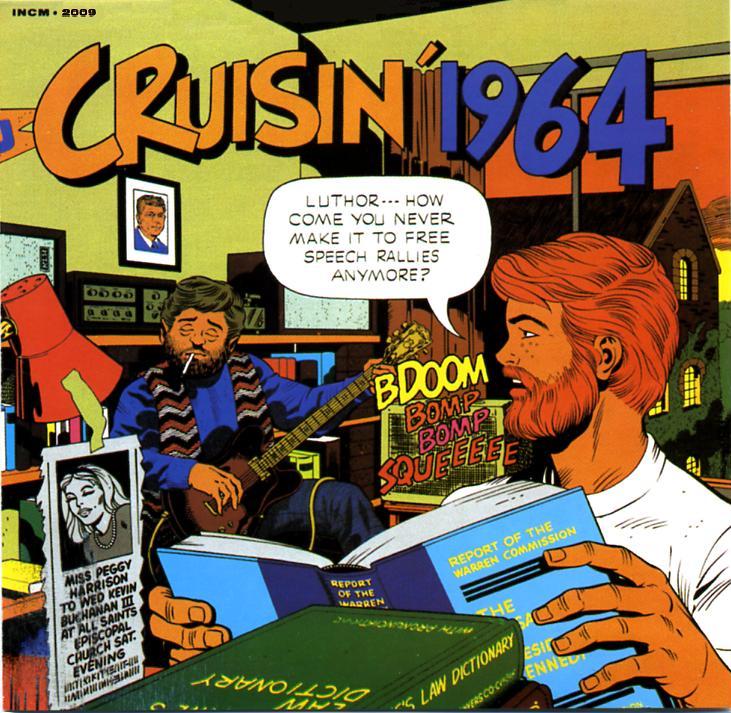
On 10-10-10 at 10:10, more of the Cruisin' series from Who Da Guy Ron Jacobs. This is radio as it was in 1964 sans The Beatles who were played just about every other song and then some. Johnny Holliday may be familiar to some of you as the voice of University of Maryland sports which he has broadcast for over a quarter century.  Enjoy.


LP liner notes by Jerry Hopkins - The Johnny Holliday in CRUISIN' 1964 was the "original" Johnny Holliday — lots of disc jockeys were "assigned" that name in later years — and in this, the year the Beatles invaded the U.S., he was No. 1 in the ratings from 3 to 7 p.m. on WHK, Cleveland.

Holliday, if possible, went even faster than B. Mitchell Reed (CRUISIN' 1963), probably thanks to his experience announcing sports in Cleveland, and every word was perfectly enunciated, thanks, perhaps, to his two seasons of Cleveland summer stock. Plus: he savored the rhymed cliche unlike any other ("let's click the turnstiles in our wax files," "headed for the tippety-top of the ol' pop crop") and went absolutely bananas over alliteration (he broadcast not from a studio, but a "platter pad," conducting a "platter patrol"). In the vales of verbal virtuosity, Johnny Holliday was the Master Mouth, a Tour de Force de Tongue.

Holliday, who had been with WHK since 1959, wasn't just known for his delivery speed and sleight. Over the years he'd won dozens of public service awards and while with WHK organized station basketball and softball teams which raised over $100,000 for local charities.

For much of America, 1964 moved almost as rapidly as Holliday's mouth, for this is when Top 40 radio stations began clocking the time in "Beatie minutes before (or after) the Beatie hour" and reported the temperature in "Beatle degrees." For a while there, the four "mop-tops" had five of the top 10 places in the singles chart, three of the top five albums. And when the "fab four from Liverpool" appeared on "The Ed Sullivan Show," an astonishing 73 million people were watching — nearly 45 per cent of the entire U.S. population! Beatlemania had struck.

Of course the Beatles didn't control the record charts, they merely seemed to. Roy Orbison was back with Oh Pretty Woman; Marvin Gaye, Mary Wells and the Supremes were there for Motown; the Four Seasons sang Dawn and Rag Doll; Barbra Streisand recorded People; the Drifters cut the classic Under the Boardwalk; the Beach Boys continued their '60s chart run with I Get Around; Ray Charles released Busted; Nino Tempo and his sister April Stevens won the "best song" Grammy with Deep Purple, and all were joined by the Swingle Singers, Tony Bennett, Al Hirt, Andy Williams and the Singing Nun.

As is often the case, TV Guide probably told more about America than any other text, for here were listed "The Man from U.N.C.L.E.," "The Munsters," "Bewitched," and "Peyton Place." And between those wonderful shows came charging the White Knight and the White Tornado and, singing and grinning insipidly, the wonderful Doublemint Twins. Only "Shindig" and "That Was the Week That Was" seemed related in any way to youthful reality.

And reality was grim, as three civil rights workers — Michael Schwerner, Andrew Goodman and James E. Chaney — were murdered by the KKK in Mississippi ... the Warren Commission Report made the claim that Oswald did it alone ... Lyndon Johnson stormed into the White House over Barry Goldwater ... and the U.S. began bombing North Vietnam — four of several incidents that put young America on the march again.

Such matters were seldom mentioned on Top 40 radio, certainly not on Johnny Holliday's "wonderful funderful platter patrol." Here everything was designed for your driving and dancing pleasure. One of the most unusual songs on CRUISIN' 1964 isn't a "song" at all, but a commercial for Rambler, an automobile whose ad agency acquired the rights to a 1958 hit by the Playmates called Beep Beep (CRUISIN' 1961) and wrote new lyrics. Of course the "song" was still about the mighty little Nash.


Sunday, October 03, 2010

B. Mitchell Reed - WMCA New York 1963

If John Milner didn't like the changes in rock & roll circa 1962, he wasn't gonna change his mind in '63. Popular music was progressing so fast that it would be nearly unrecognizable in the next few years. The Beach Boys, Beatles and Motown's Berry Gordy weren't looking back. This year would mark the end of the innocence for America as Camelot was about to disappear without warning. You'd never know it by listening to this faux aircheck, but isn't that the idea?  Enjoy.


LP liner notes by Jerry Hopkins - When B. Mitchell Reed returned to his native New York in early 1963 to take over the seven-to-eleven evening shift as one of WMCA's "Good Guys," he was known as — coming from Hollywood radio — "The Fastest Tongue in the West." Fifteen seconds into this CRUISIN' volume and it will be abundantly clear why. In many ways, Reed epitomized the early '60s radio sound, where sound effects, noisemakers, commercials and songs rattled like machine guns on the firing line. Reed's jivey 10O-mile-an-hour rap was unequalled, and perfectly tailored for the time and medium.

BMR, as he is known today, Mitch to his friends, might have seemed an unlikely candidate for Top 40 radio because he had a masters degree in political science and early in his career, as WOR's successor to the original "Symphony Sid," had been strongly identified with a different sound, hosting the all-night "Birdland Jazz Show." But regardless of what records he played, Reed was colorful. Nick-names — an often self-conscious display of ego indigenous to pop radio — began piling up like aliases in a Damon Runyan anthology: "The Boy on the Couch," "The Mad Monk in the Monastery," "The Fastest Tongue ..." and when he grabbed the No. 1 spot in New York at WMCA, leaving Murray the K and Cousin Brucie tap-dancing for second, "Your Leader, the Nuttiest on the New York Turf."

Reed's first year as a "Good Guy," 1963, was a pivotal year for popular music. Half a dozen musical trends continued as Jan & Dean recorded Surf City, Chubby Checker abandoned the twist for Limbo Rock, Edye Gorme told everyone to Blame It On The Bossa Nova and Trini Lopez popularized an old Lee Hays-Pete Seeger tune, If I Had a Hammer. More significant, this was the year Motown made its first real impact, with Little Stevie Wonder's Fingertips, Heat Wave by Martha & the Vandellas, the Miracles' You've Really Got a Hold On Me and the first hits of Mary Wells. Then Peter, Paul & Mary established a young singer-songwriter named Dylan with Blowin' in the Wind and Don't Think Twice. And in the last months of the year, the Beatles appeared. The new styles, the new sounds, were set.

The national scene was in greater, more shocking flux. School prayer was ruled unconstitutional by the U.S. Supreme Court. Over 200,000 civil rights demonstrators gathered in Washington to hear Martin Luther King say, "I have a dream ..." A nuclear test-ban treaty barring all tests except those conducted underground was signed with Britain and the Soviet Union. The U.S. Surgeon-General linked smoking and cancer. And President Kennedy was shot.

By year's end, so numbing was the assassination, nearly all of 1963's diversions seemed forgotten. Gone from recent memory were the year's three top award-winning films, "Lillies of the Field," "Hud" and "Tom Jones." Gone were Koufax and Drysdale and Podres, the Dodgers' triple threat. Gone were all those elephant jokes. The show presented on this volume of the CRUISIN' series is from a period six months earlier.


Sunday, September 26, 2010

Russ "The Weird Beard" Knight - KLIF Dallas 1962

We're now up to the year of our favorite film. And this Cruisin' album/show makes a nice companion piece to the American Graffiti soundtrack. Russ Knight was crazy popular in Dallas. More than sixty percent of active radios were tuned to his show. His ratings still stand as a record in that region's nighttime radio history. Certainly not as wild on the air as Wolfman Jack, 'The Weird Beard' shared the Wolfman's sense of bizarre humor. Enjoy


LP liner notes by Jerry Hopkins
Now CRUISIN' goes to '62
Lay some groovies over you
Recreate the good ol' days
Twistin' in the summer haze
Screamin' rhythm, diggin' you
It's early Sixties radio-ooooo
That's the way Russ "The Weird Beard" Knight might introduce this volume of the CRUISIN' series. In 1962 Russ was a beefy college grad with a Masters degree who found himself holding down the seven - to - midnight show on KLIF in Dallas. By 1962 all the radio production gimmickry that had been developing reached some sort of zenith in kitsch artistry. And Russ Knight, graduate journalism degree and all, was perfectly suited to the medium (and message). His voice rose and fell with facility, moving up and down the scale like an express elevator. He had a nickname (and a weird beard to match it) and a fan club and he called himself the "savior of Dallas radio." Damned near everything he said rhymed. Horns honked and everything echoed echoed echoed. It was high powered radio cacophony at its best.

Even the jingles and commercials had extra pzazz - thanks in large part to an outfit called PAMS (Production, Advertising and Merchandising Service) in Dallas. PAMS was begun in 1951 and by 1962 had produced thousands of musical pitches and promotional spots, influencing pop radio nationally. Many of these spots are on the CRUISIN' series.

Prior to 1962, rock and roll, and pop radio, had gone through some harsh years. Since 1959 most of the music had been rather bland. There hadn't been much happening and in '62 there seemed to be a searching for the next "thing." So this was a year the television networks recognized the folkies and made "Hootenanny" one of several regularly scheduled folk music shows. Others had their eyes on California's coastline, where the Beach Boys went on a Surfin' Safari, starting a second "trend." Still more thought the wave of the future was coming from Brazil in the bossa nova beat, while the dance madness (essentially the twist) hung on like a dog to a meaty bone. Nor had the blandness disappeared totally; there are several superb examples of gingerbread left over from the early Dick Clark era in this volume of CRUISIN'.

1962 was many things musically - somewhat exciting (certainly not so boring as '59, '60 and '61), extremely commercial (surfboards, twist clubs, TWO "Hootenanny" magazines), and somehow encouraging, no matter how apparently directionless. It was, if nothing else, a peculiarly "pop" year - a year when pop culture and all its inherent fallout occupied everyone's thoughts.

It was when Herman Taller's "Calories Don't Count" topped the year's best-selling book list, (although more copies of the "JFK Coloring Book" were sold.) John Glenn circled the earth three times. The New York Daily News sent a reporter to Harvard University to check reports one of its professors, Timothy Leary, was feeding his students unusual drugs. "Lawrence of Arabia" took the best picture Oscar. And the Yankees took the pennant again.

More seriously, President Kennedy faced down the steel industry when it tried to boost prices and later in the year faced Khrushchev down, telling him to take his missiles out of Cuba, or else. Congress investigated The Fabulous Frauds of Billie Sol Estes. The Soviets orbited two cosmonauts in two space ships, simultaneously. Francis Gary Powers was returned to the U.S. in history's best-publicized spy-swap. Arthur Goldberg and Brian (Whizzer) White were named to the Supreme Court. And 1,113 Cuban invasion prisoners were ransomed with $53 million in medicine and baby food.


Sunday, September 19, 2010

Arnie 'Woo Woo' Ginsburg - WMEX Boston 1961

Our east coast Coupe building buddies will probably remember cruisin' to 'Woo Woo'. He was a huge name in Boston broadcasting for thirty plus years. As the liner notes point out, nothing really new on the music front but radio was still fun and Ginsberg made the most of it. Some great tunes on this faux aircheck, including at least four that would later show up on the American Graffiti soundtrack. Enjoy.


LP liner notes by Pete Johnson - The year is 1961 and CRUISIN' presents radio, just as it was then. Like the other volumes of the CRUISIN' series, this record consists of hit songs, radio commercials, jingles, disc jockey chatter and other audio memorabilia from the year. Our host for '61 is Boston's own Arnie "Woo Woo" Ginsburg, the city's number-one disc jockey from 1956 to 1967. Arnie's WMEX show was called Night Train and, through a curious chain of associations with the sound of trains going "Woo Woo" in the night, Mr. Ginsburg gained his nickname. He was virtually a household word in the New England area thanks to a promotion by the Adventure Car Hop which offered two-for-one specials to any customer who mentioned "Woo Woo" Ginsburg. Adventure also named a special dish after him, the Ginsburger. Arnie's Friday night record hops at the giant Surf Ballroom in Nantasket Beach were a year-round tradition for a decade and every name artist and group eventually played there with Arnie. He was on the air continuously for twelve years and his youthful following was fantastic in its devotion, possibly because he transformed adolescent insecurities into a triumph. His voice — a continual teenage crack — combined with the constant clatter of kazoo, cowbell, buzzer, bermuda bell, car horn, oogah and train whistle, epitomized the noisy awkwardness of teenagery, but Arnie managed to bring it all off with humorous grace.

A glance at the titles from this volume of the CRUISIN' series will confirm that 1961 was a musically nondescript year. There were, as there are in any year, some outstanding rock and roll records, but there were no exciting trends; there was no sense of growth. In some ways, the musical doldrums of the year could be credited to the aftermath of the Payola hearings of 1959 and 1960. Some of radio's most influential and colorful figures had their wings singed by the Washington investigation. The exposure of their loss of real or imagined innocence turned things gray for a while.

Inevitably, with the erosion of the power of some of radio's key rock and roll figures, Top 40 radio was on the rise. With its limited number of playable records, chosen on a relatively conservative basis, and its de-emphasis of the radio personality, Top 40 programming tended to homogenize popular music. 1961 was one of the most homogenized years.

Historically, it was also a bland time. Despite the dynamism which John F. Kennedy projected from the White House, the tide of human affairs seemed to be running against the United States. We severed diplomatic relations with Cuba and shortly afterwards fell on our faces in the Bay of Pigs. The East Germans constructed a wall between East and West Berlin, creating fears of war. Yuri Gagarin, a Russian cosmonaut, became the first man to orbit the earth.

From the vantage point of 1961, it seemed as if the country were doomed to normalcy. Russia remained the huge vague threat she always seemed to be. Political activism was at a low ebb on campuses. Joe College didn't listen to rock and roll. That was for high school. He also didn't grow his hair long. That was for Beatniks. College was an ivory tower with few ties to the surrounding terrain. Surfing was becoming a huge youth cult on the West Coast and it had become identified with a simple brand of twangy guitar music, but no one had yet thought to set words to it.

A lot of musical — and attendant social — excitement had happened in the Fifties and there was a lot to come in the Sixties, but the early part of this new decade was its least exciting portion. Rock and roll seemed to be settling into a paunchy middle age and it was fitting that, as Billboard (the music trade magazine) reported in March of 1961, Chuck Berry had closed his St. Louis night club and was opening a 30-acre amusement park in Wentville, Mo. Thus did one of the founding fathers of rock and roll join the landed gentry. On January 15, 1961, Chuck Berry was 30 years old.


WMEX Boston 1961 - Arnie 'Woo Woo' Ginsburg

Sunday, September 12, 2010

Dick Biondi - WKBW Buffalo 1960

Today's Crusin' 1960 Living Radio submission features the East Coast's mondo popular Dick Biondi in 1960. And don't forget race fans, you can take a listen by pressing the arrow on the DivShare player at the bottom of the post. And if you dig it the most, just right click on the title underneath the player and you can save it to your computer. Enjoy.

'da Hui no ka oi


LP liner notes by Jerry Hopkins - It's 1960 and the CRUISIN' series goes to WKBW in Buffalo, New York, where Dick Biondi exercised one of the most powerful sets of lungs in pop radio. Good old screaming Dick Biondi — "the wild Eye-trallan, the supersonic spaghetti slurper" (his own description), a man who could read at random from the real estate classifieds and make it sound like headlines for Armageddon. He went to Memphis and picked leaves from Elvis Presley's lawn, awarding them to his listeners. On holidays the "Big Noise from Buffalo" devoted three hours to telephone greetings from the top recording stars. Daily he joked with his radio pals and hollered at his listeners. He read commercials in a high-pitched shriek, dedicated songs to everybody's certaln someone in a breathless, lurching wail that traveled seventeen Eastern states. (Mail came from as far away as Havana and Greenland.) And he ate peanut butter and sauerkraut pizzas on the air and told knock-knock jokes so corny they made you suffer. Almost half of the Buffalo audience was his. It was listen to Biondi, or else.

In a way it was as if Biondi were trying to pump some enthusiasm and excitement into a scene that was sagging pitifully. In 1960 the Congressional payola probe continued; in Philadelphia alone twenty-eight disc jockeys were canned. Rock also lost two more of its early stars, as one auto crash took Eddie Cochran in England (hospitalizing Gene Vincent) and another took Johnny Horton as he was en route to a show in Nashville. Even in the music there was death, as Ray Peterson sang about a stock car driver who entered a race to win money for a wedding ring, crashed and sang as his final words: Tell Laura I Love Her. (Of course dozens followed right along, recording saccharine smash hits of their own.) Rock and roll's demise, like that of Mark Twain's, had been greatly exaggerated — music with a beat still dominated sixty per cent of the Top 40 — but more than Biondi's screech was needed to bring things back to an exciting peak. Not all was gloom and doom, certainly. Elvis was back, after appearing in a film about an Army tank sergeant (natch!) called "G.I. Blues", and warbling just like the good old days. Sam Cooke, the Everly Brothers, Ray Charles, Jackie Wilson and several others of real talent had hits.

Historically the scene was equally mixed. (As usual.) The French joined the nuclear club by exploding an A-bomb in the Sahara, Francis Gary Powers and his U-2 reconnaissance plane went down in the Soviet Union. (President Eisenhower got caught in a lie when he said he didn't know anything about the U-2s.) Adolf Eichmann was captured in Argentina. Cuba began confiscating Amerlcan-owned factories on the Island. After spending twelve years on Death Row, Caryl Chessman was executed. The first sit-in was held in a Woolworth's in North Carolina. And John Kennedy was elected President.

Other events of the year (some headlined, some unrecognized publicly): Pittsburgh took the World Serles from the Yankees ... George Martin (who'd later produce records for the Beatles) was named to EMI's artist and repertoire staff ... Allen Drury's "Advise and Consent" was given a Pulitzer Prize ... "The Apartment" (starring Jack Lemmon, Shirley MacLaine and Fred MacMurray) got the Oscar for best picture ... and Bob Dylan was a freshman named Robert Zimmerman at the University of Minnesota.


WKBW Buffalo 1960 - Dick Biondi